Bringing home the
bacon
Story by Sheridan
Rogers
It's
a frosty winter Tuesday morning in the Victorian border town
of Wodonga and butcher Robert Formichi is so cold he can
barely move his lips to talk.
He's just received a delivery of 18 white headless female
pigs and is due to begin processing them.
"It
takes us all day to bone them out by hand," he says.
"There are only two of us and we take out all the muscles
and tendons, sort the meat into different grades, then do the
mincing."
They average 75kg - 85kg in weight with approximately 10ml - 13 ml fat.
"We spend a lot of time cleaning and preparing them before
we progress to making the various smallgoods (which include
sausages, salami, prosciutto, pancetta and ham). We use
the shin and back skin in our 'cotechino', minced
separately then seasoned and put into sheep's skin casing.
We never use offal or the skin from between the legs or tits
because it gives a sour taste. Many people use extra
garlic and spice to offset that but you can smell is as soon
as you walk in.
"When
people taste our 'cotechino', they say 'Oh my god, that's how it used to taste'. There's nothing like
it to warm you up in the middle of winter."
His story is typical of the families of post-war European
migrants who settled in the Albury-Wodonga region, many of
whom brought their skills and age-old recipes for everything
from pastrami and smoked beef mettwurst sausages to pancetta
and black puddings with them to Australia. They set up
continental butcher shops complete with their own smokehouses
in the border towns. Today, thanks to fathers passing their
specialist and often highly guarded knowledge onto their
children, many of these traditions are still alive and well.
Back
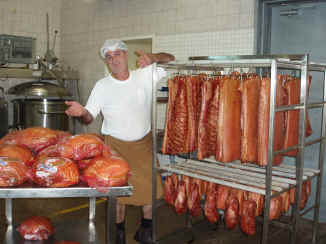
then there was no refrigeration and the best way to preserve
meat was to cure and smoke it. "In those days we'd
light a fire to get the desired colour in the smoke on the
concrete floor and the meats would hang from the ceiling,"
he explains. "Then we'd unhook it and put it into a water
copper to finish cooking."
"We
no longer do it that way but the methods - the salts and
seasonings and how long we cure the meat before smoking - are all the same."
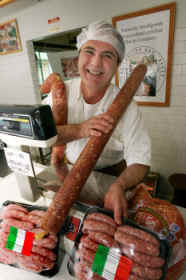
Rob
Formichi learnt his trade from his father who had migrated to
Australia in 1956 from Lucca in Tuscany. Although he
originally wanted to be a doctor, he now reckons that being a
salami maker is the next best thing. He left school at
14 to give his father a hand in the business and never
returned to formal education.
"Mum and Dad were in Bonegilla Migration Centre
(Australia's largest post-war immigration centre) for a
couple of years and then bought a block of land in Kelly
Street Wodonga," he explained. "We lived in the
garage at the back of the street front shop and Dad built a
concrete smokehouse, about the size of a toilet."
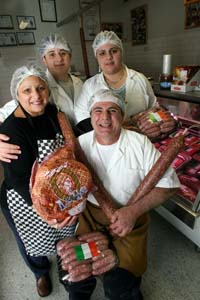
Mother Orfea, now in her early 70's, still lives next door
to the shop while Robert's wife Rose and children (Susan, 18
and Steven, 16) live across the road. All the family help in
the business along with Paul Cag (or Macka to friends) who has
been Formichi's assistant for the past 25 years.
"We're
simple, nothing flash," he says. "We've worked hard for
what we've got. It doesn't work when I put other
people on because they say 'that's not how I was
trained'. Everyone stirs the pot different, everyone's
kitchen is different." He's clearly passionate about his
work.
"I'm
an 'artista', a painter", he explains. "When we go to
the farmers' market in Albury, I hang up my photos because I
can't fit them all on the bedroom wall then get out my
microphone and talk to the customers."
Despite
the many food regulations favouring mass production in
smallgoods, Formichi belongs to a long line of artisans
devoted to following traditional methods of food preservation.
"There
are only a few continental butchers left today," he
comments. "Everything's gone to technology - chemicals
are used to counteract chemicals.
Some
of the big companies cook their products under steam and use
atmospheric sprays like brown hickory smoke. It's like
getting a false tan without the flavour.
Just wait till they start spraying the girls!
"It's
gone beyond a joke. I followed that path 20 years ago and used
pre-mix in my sausages because it extends 10kg of meat to
17kg, but the flavour wasn't there. Today my pork
sausages are made from 10kg pork meat, a glass of wine or two,
some garlic and salt and pepper, that's it. And they're
all tied by hand."
His
boned-out prosciutto (or 'culetto') is cut from the
silverside of the leg, dry salted and seasoned with herbs,
garlic and pepper then cold smoked to help with the drying.
Australian Oregon or ash for smoking because imported woods
are irradiated.
"It
takes three months from start to finish. To do a 10kg leg
takes 10 - 11 months and a bigger leg takes up to two years.
We do the 'pancetta' the same way but with belly of
pork."
He
also makes a range of other European smallgoods including
Vienna frankfurts, Polish sausage, Kaiserfleisch,
Kassler (smoked pork chops) and cheese Kransky. Many of the migrants from Bonegilla settled around the border
region and came from as far away as Russia, Germany, Poland
and South Africa.
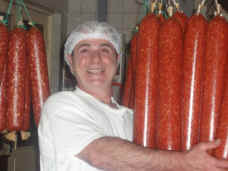
Formichi
is one of a handful of artisan butchers left. Fifty
years ago there were 20 continental butchers in Albury and at
least six in Wodonga and most of today's customers didn't
originate from Europe. Most of the migrants are now in
their 80's and their children don't eat the same.
Unlike
many, the Formichi's have managed to keep their family
tradition alive.
"We're from the old school - respect your elders, open
the door for ladies and treat people like you want to be
treated," he remarks.
"Mangiare
mangiare," Rose calls out from the kitchen. It's
time for lunch and the family is about to sit down to one of
Robert's favourites - 'coco con conserva' - a rustic
Italian dish of tomato sugo cooked with a little olive oil and
oregano. "We break eggs into it, stir 'em with a wooden spoon and
spread it on toast. It's magic! In the evening we all sit
down and eat and talk together."
And just watch those lips.
(Courtesy of Sheridan Rogers www.sheridanrogers.com
and Outback Magazine www.outbackmag.com.au
)














 Reproduced Courtesy